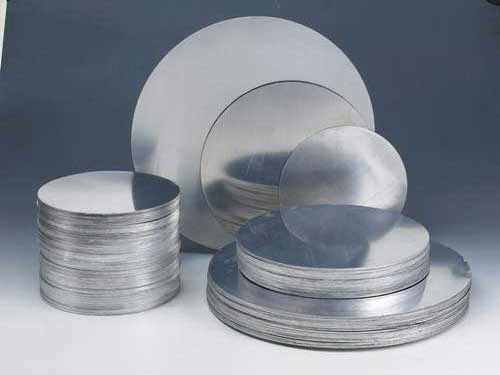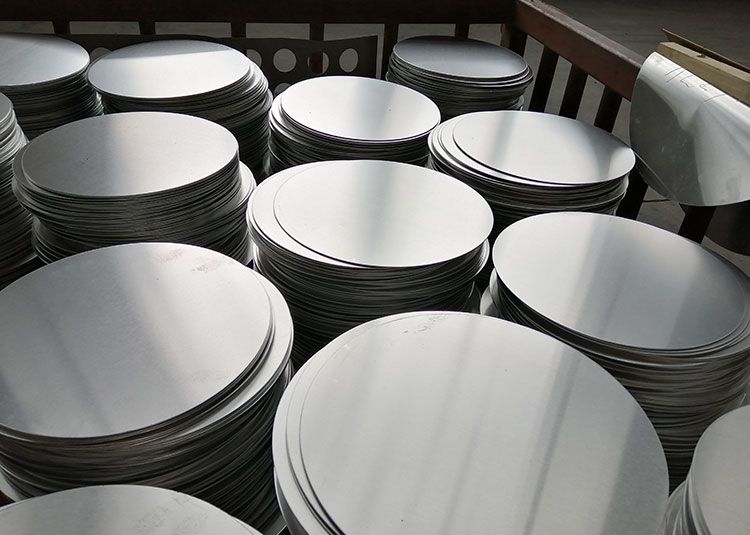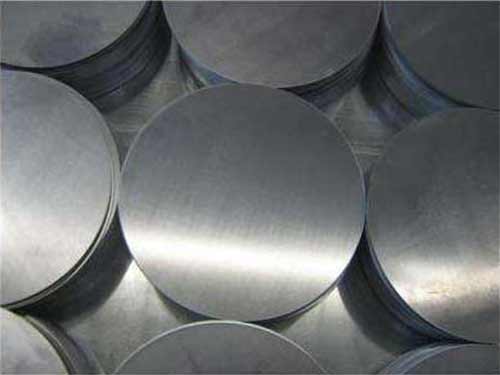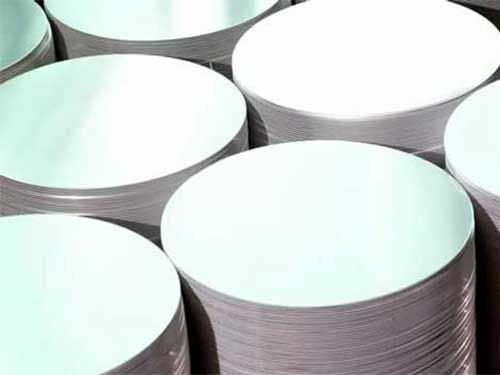

Alloy 1050, 1060, and 1070 aluminum disks (also called aluminum circles) are often introduced as "pure aluminum" materials, but their real value is more practical than that label suggests. In manufacturing, these disks behave like a reliable blank canvas: they accept deep drawing, spinning, stamping, and heat transfer design choices with minimal surprises. When supplied in HO, H12, or H14 temper, they become a controllable starting point for cookware, lighting reflectors, electrical components, and a long list of formed parts where surface quality and predictable forming matter more than extreme strength.
What makes 1050/1060/1070 aluminum disk unique is not a single headline property-it is the way their functions align with real production needs. They are chosen because they form smoothly, conduct heat and electricity efficiently, resist corrosion naturally through their oxide film, and keep costs stable thanks to broad industrial availability. In short, they reduce risk on the shop floor while supporting high-throughput manufacturing.
Why these alloys work so well as "forming-first" disks
In many applications, the disk is not the final product; it is the beginning of a forming process. The best disk is the one that does not crack at the flange, does not orange-peel after forming, does not create inconsistent ears, and does not force constant die adjustments. 1050, 1060, and 1070 are high-purity aluminum grades, so they typically show excellent ductility and a forgiving forming window-especially when matched with the right temper.
Their "function" can be understood as process efficiency: fewer rejects, less tool wear sensitivity, and cleaner surfaces after forming or spinning. That is why you will see these alloys used heavily in cookware bottoms, pressure cooker liners, lamp shades, reflector bowls, signage blanks, and spun parts where surface finish becomes part of the brand image.
HO vs H12 vs H14: temper as a manufacturing control knob
Temper is not just a mechanical label; it's a practical way to tune the disk for a specific forming route.
HO (often written as O temper) is fully annealed. It delivers maximum elongation and the best deep draw/spinning performance. When a part requires aggressive forming, multi-step draws, or tight radii without cracking, HO is typically the safest choice. It is also favored when the manufacturer plans to perform subsequent forming operations and wants consistent behavior from batch to batch.
H12 is a half-hard, strain-hardened temper with a moderate increase in strength compared to HO while retaining decent formability. It is often selected for parts that must resist handling dents or maintain shape better during forming and transport, yet still need to be stamped or lightly drawn.
H14 is harder than H12, offering higher strength and better resistance to surface damage, with reduced formability compared to HO. It suits applications where the disk experiences less severe deformation, or where stiffness and dimensional stability are more important than deep drawing capability.
Choosing among HO, H12, and H14 is less about "good vs better" and more about aligning the disk's behavior with your forming method, tooling, and desired surface outcome.
Applications that benefit from 1050/1060/1070 aluminum disks
Cookware and kitchenware are the classic examples because these alloys transfer heat efficiently and form smoothly into pots, pans, lids, and inner liners. For cookware, stable thickness, clean surface, and consistent grain behavior affect not only forming yield but also the final appearance after anodizing, polishing, or non-stick coating.
Lighting and reflectors are another strong fit. High-purity aluminum alloys can provide attractive reflectivity and respond well to surface finishing. Disks are spun or pressed into lamp shades and reflector geometries, where uniform surface and low defect rate matter.
Electrical and thermal applications take advantage of conductivity. Disks can become transformer components, capacitor cases, heat spreaders, or parts where current flow or heat dissipation is important. While these alloys are not "high strength," their conductivity-to-cost ratio is compelling.
Signage, nameplates, and decorative parts rely on the clean surface and corrosion resistance. These disks accept anodizing and other finishes well, supporting consistent color and gloss.
Typical parameters customers evaluate
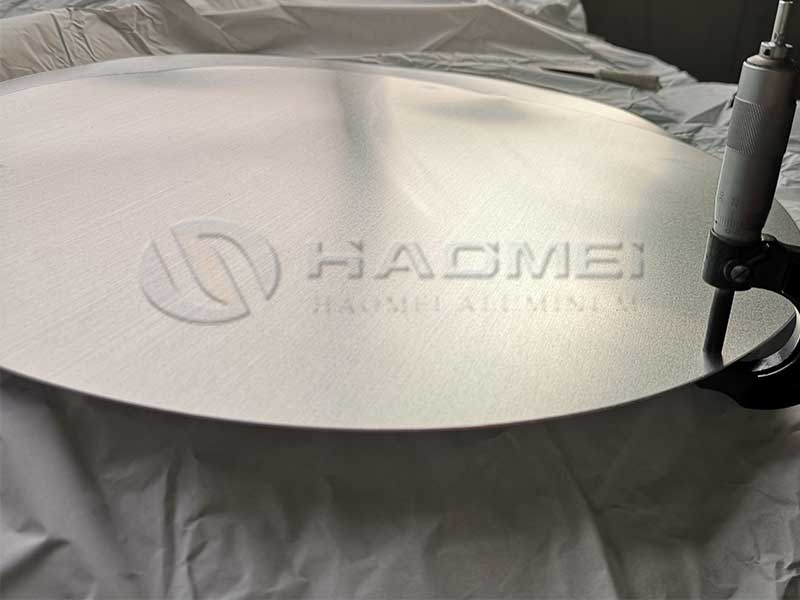
Aluminum disks are usually specified by alloy, temper, thickness, diameter, and surface quality. Common production ranges vary by supplier, but many customers request thicknesses from about 0.3 mm to 6.0 mm and diameters from about 80 mm up to 1200 mm, depending on equipment and end-use. What matters most is not just the nominal size, but tight control of thickness tolerance, flatness, burr height, and surface defects, because those factors directly influence stamping stability and finish yield.
Manufacturers also pay attention to grain structure and earing performance for deep drawing. A well-produced circle-often from high-quality DC (direct chill) or CC (continuous cast) coil and optimized rolling/annealing-reduces earing and improves material utilization.
Implementation standards and commonly referenced specifications
Depending on the market and customer requirements, aluminum disks may be produced and inspected under standards and specifications such as:
- ASTM B209 for aluminum and aluminum-alloy sheet and plate (often referenced for chemical/mechanical expectations of the parent stock)
- EN 573 (chemical composition) and EN 485 (mechanical properties) for wrought aluminum products in European contexts
- JIS H4000 / JIS H4040 series references may appear in some Asian supply chains for aluminum materials
In practice, many aluminum circle purchases are driven by a combination of a general standard and a supplier's internal control plan for circle-specific properties such as edge quality, burr limitation, and surface cleanliness.
Chemical composition: how 1050, 1060, and 1070 differ
The difference among these alloys is purity. Higher purity generally improves conductivity and can enhance corrosion resistance and surface response, while slightly lowering strength. Below is a commonly used reference range for typical maximum limits (exact limits can vary by standard revision and mill practice; final values should follow the agreed certificate/standard).
Typical chemical composition (wt.%)
| Alloy | Al (min) | Si (max) | Fe (max) | Cu (max) | Mn (max) | Mg (max) | Zn (max) | Ti (max) |
|---|---|---|---|---|---|---|---|---|
| 1050 | 99.5 | 0.25 | 0.40 | 0.05 | 0.05 | 0.05 | 0.05 | 0.03 |
| 1060 | 99.6 | 0.25 | 0.35 | 0.05 | 0.03 | 0.03 | 0.05 | 0.03 |
| 1070 | 99.7 | 0.20 | 0.25 | 0.04 | 0.03 | 0.03 | 0.04 | 0.03 |
This purity shift may look small on paper, but it can matter when the disk's job is to conduct heat, reflect light, or deliver consistent surface finish after anodizing.
Mechanical expectations by temper (practical guidance)
Mechanical properties depend on thickness and exact processing route, but the trend is consistent: HO is softest and most formable, H12 is intermediate, H14 is stronger and more dent-resistant. For buyers, the most useful approach is to specify the temper by forming method and require mill test certificates, while validating performance via a small forming trial if the part is sensitive.
A distinctive way to select the right disk: think in "failure modes"
Instead of selecting alloy and temper by habit, consider what you are trying to prevent.
If your biggest risk is cracking during deep drawing or spinning, prioritize HO temper and consider 1050/1060 for maximum forming forgiveness.
If your biggest risk is dents, waviness, or loss of shape during handling and assembly, H12 or H14 often reduces those problems, especially for flatter stamped parts.
If your biggest risk is thermal performance variance, higher purity like 1070 can be attractive, particularly where conductivity consistency is tied to product performance.
That mindset turns "1050 vs 1060 vs 1070" and "HO vs H12 vs H14" into a clear engineering choice rather than a catalog selection.